Songs for Persephone: Mimi Goese & Ben Neill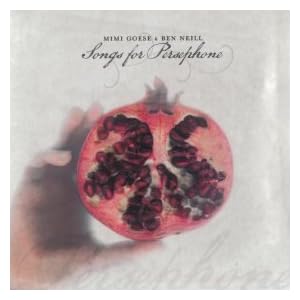
Take a seductive voiced art-pop singer and a post-jazz/alt-classical trumpeter. Add fragments of nineteenth century classical melodies, electronics elicited by a “mutantrumpet” controller. Then add influences ranging from ancient Greek mythology to the Hudson River Valley. What you have are the intricate yet intimate sounds on an evocatively beautiful new CD:
Songs for Persephone. The Persephone legend is one of the oldest in Greek mythology, with many variants that provide twists and turns to the narrative and subtext of the story. In the myth, Persephone, daughter of Zeus and the harvest goddess Demeter, is kidnapped by Hades, god of the underworld. During her absence, vegetation is unable to grow in the world; fields fall fallow and crops cannot be harvested.
To break this horrible time of famine, the gods come to an understanding with Hades. Persephone is eventually freed, but on the condition that, if she has eaten anything while in Hades’ realm, she must return to his kingdom for a certain length of time. Thus, each year she must remain in the underworld one month for each pomegranate seed that she has consumed. This serves to rationalize, in mythic terms, the change of seasons, times of decay and renewal, shifts in light and weather; even the autumn foliage and the falling of the leaves.
Vocalist
Mimi Goese and trumpeter
Ben Neill have updated the Persephone story, while retaining its iconic essence, on their new recording
Songs for Persephone (out now on
Ramseur Records). As one can see from the pomegranate on the cover, (a visual designed by Goese), the duo is mindful of the legendary Persephone’s history; but they are not hung up on providing a linear narrative.
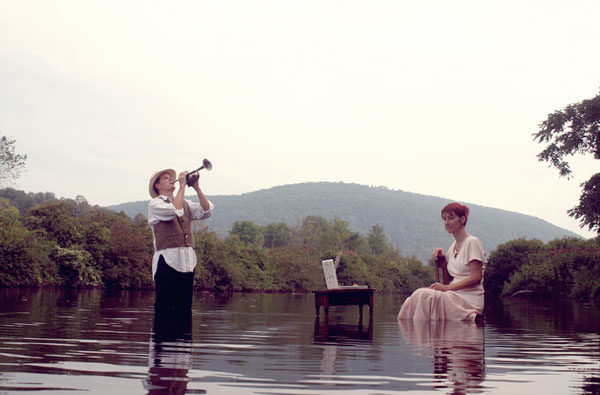
In a recent phone conversation, Goese, who wrote the album’s lyrics, said, “The artwork that I did for the cover, featuring the pomegranate, is one acknowledgement of the myth of Persephone. And there are other images that I found in the lyrics. But we were interested in using what was evocative about Persephone to create our own story. That’s sort of how the myth evolved too – one storyteller picks up the thread from another down through the years.”
They started work on this music some five years ago, but originally presented it as part of a theatrical production by the multimedia company Ridge Theater, starring
Julia Stiles. In 2010, it was produced at
Brooklyn Academy of Music as part of the
Next Wave Festival.
The theatrical presentation and the mythological story behind it are only two strands in a disparate web of influences that resonate with
Songs for Persephone. Both Goese and Neill make their home in the Hudson River Valley. Both for its stunning natural surroundings and its history as a home for artists of all sorts, the valley is rich with reference points. Neill feels that these are subtly imparted to the music.
In a recent phone conversation, he said, “I found myself particularly interested in the Hudson River School of painters. These Nineteenth Century artists depicted the local landscape and the changing of season with a dimensionality and symbolism that seemed to have an affinity with what Mimi and I were after in
Songs for Persephone.” For Neill and Goese, these extra-musical influences – artwork, nature, and theater – are an important part of the music’s genesis. But the polystylistic nature of their music making adds still another layer to the proceedings.
Goese says, “I started in dance and theater and later moved to performance art. Singing came along later. But I don’t have the musical background or training that Ben has – I’m self taught.”
[youtube]http://www.youtube.com/watch?v=oG1XgKytxd0[/youtube]
She doth protest too much. Goese’s voice provided the steely, dramatic center to the work of late eighties band
Hugo Largo. One part art rock and another dream pop, the group incorporated bold theatricality and ethereal experimentation, releasing two memorable full lengths,
Arms Akimbo and
Mettle, and the
Drums EP, an alt-pop connoisseur’s delight. She’s also collaborated on several occasions with
Moby and, under the moniker
Mimi (no last name) released
Soak, a solo album on
David Bryne’s Luaka Bop label.
Goese is a powerful singer, but
Songs of Persephone brings out the lyricism her voice also possesses. Cooing high notes and supple overdubbed harmonies are juxtaposed with the more muscular turns of phrase. Experience plays a role in Goese’s tremendous performances on the disc. But she also credits the musical creations of her collaborator Neill with spurring on her inspiration.
“Ben has been a terrific person with whom to work,” Goese says. “He’s inventive and willing to try new things. From the moment we first performed together, at a concert nearly a decade ago, I’ve felt an artistic kinship with him.”
One can readily hear why Neill’s music would be an engaging foil for Goese. His background as a producer, and his years of work designing the mutantrumpet, have encouraged Neill’s ear toward imaginative soundscapes. His 2009 album
Night Science (Thirsty Ear) is an example of Neill’s nu-jazz arrangements and soloing at their very best.
On the current CD, Neill’s playing remains impressive; but his arranging and collaborative skills come to the fore. There are intricate textures to found, on which Neill’s trumpet and electronics are abetted by strings, bass, and drums, but it’s the melodies, floating memorably past, one after the other, that are most impressive here. Some of the melodic lines he crafts are imitative of the voice in their own right: it’s no accident that some of the most inspired music-making on
Songs for Persephone are when Goese and Neill create duets out of intricately intertwined single lines.
Neill says, “The classical materials that I used as the basis of the compositions on Songs for Persephone were melodies from the Nineteenth century: from opera and symphonic music. Many of them were from relatively the same era in which the Hudson Valley painters worked. I found it fascinating to juxtapose these two genres that were in operation more or less at the same time.”
He continues, “I’d describe the material as fragments of melodies: small excerpts rather than recognizable themes. None of them are treated in such a way that most listeners will be able to say, ‘Hey that’s Berlioz,’ or ‘That sounds like Schumann.’ They were meant to be a starting point from which I would develop the music: it’s not a pastiche.”
At 7:30 PM on September 27
th, Goese and Neill will be having an album release party at the
Cooper Square Hotel, part of
Joe’s Pub’s Summer Salon series. Goese says, “It’s an interesting space – we’ll have glass windows behind us, which is unusual as compared with a more conventional stage. But it’s fun performing in non-standard venues. It allows you to try different things and to bring different elements into the mix in terms of theatricality, lighting, and the way that you play off of each other. I’m excited to see how
Persephone changes as we take it into various performing spaces.”
-Composer Christian Carey is Senior Editor at Sequenza 21 and a regular contributor to Signal to Noise and Musical America. He teaches music in the Department of Fine Arts at Rider University (Lawrenceville, New Jersey).Labels: Crossover, electronica, interview, jazz, Pop
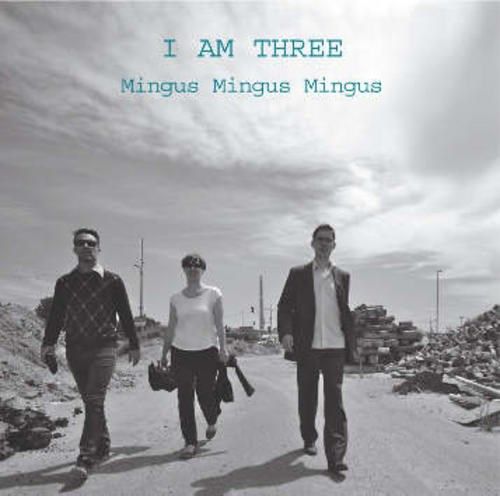 Mingus Mingus Mingus
I Am Three
Leo Records CD LR 752
The trio I Am Three, consisting of alto saxophonist Silke Eberhard, trumpeter Nikolaus Neuser, and drummer Christian Marien, interpret compositions by the late Charles Mingus on their debut release for Leo Records (Eberhard has previously recorded for the label with different configurations). Mingus is, of course, a totemic figure in jazz. But he was a musician whose work can be seen from many angles, ranging from the neo-traditional – blues and early jazz signatures abound in his work – to modern jazz and the “Third Stream” experiments of the 1950s and 60s. All of this coexists in a mélange of stylistic plurality that still retains an individual stamp.
Thus, one might rightly think that Mingus would be a difficult composer with whom to grapple. While at first the muscularity of some of his best pieces would seem to indicate a durability that would allow for an open approach, artists who distort or exaggerate one aspect of his compositions’ multifaceted nature do so at the peril of unbalancing his nearly inimitable sound world. That is, in part, what makes I Am Three’s interpretations of Mingus so remarkable. The group manages to capture the spirit of piece after piece from his output with detailed touches that show careful study of the originals. At the same time, they bring original flourishes to the table, mostly by pushing Mingus’s music a bit further “out” than its original conception might have been. All of this is accomplished without a bassist.
For example, if one places I Am Three’s rendition of “Orange was the Color of her Dress, then Blue Silk” alongside Mingus’ various recordings of it, in solo piano and full band settings, the sense of homage is clear. The syncopated chordal refrain is kept intact, as is the chirping treble register interjection - here by Neuser instead of Mingus’s piano - juxtaposed against a loping swing saxophone solo by Eberhard. All the while Marien alternates between accentuating the refrains in unison with the horns and pushing the beat slightly ahead of them to better underscore the laconic character of the solos. This all eventually devolves into a tutti passage of free jazz howling, ironically capped off by a return of the refrain in slow swing time.
“Better Get Hit in Your Soul” loses the inimitable bass and piano parts. I Am Three dispenses the tune without imitating them, focusing instead on the enwrapped horn lines and revelling in the tune’s lively groove. Neuser’s growling muted trumpet intro is a memorable feature of “Fables of Faubus,” as his succeeding polyrhythmic duet with Eberhard.
On “Self Portrait in Three Colors,” Marien’s drumming takes on an almost rock-like heaviness. After a blistering upper register tutti, once again the horns play independently minded yet intertwining solo lines. “Canon” provides a natural album closer, demonstrating Mingus’ ability to employ rigorous compositional procedures while simultaneously placing them firmly in a traditional jazz vocabulary. Mingus, Mingus, Mingus was my favorite jazz release of 2016, one to which I continued to return with great pleasure for fresh insights. Recommended.
Mingus Mingus Mingus
I Am Three
Leo Records CD LR 752
The trio I Am Three, consisting of alto saxophonist Silke Eberhard, trumpeter Nikolaus Neuser, and drummer Christian Marien, interpret compositions by the late Charles Mingus on their debut release for Leo Records (Eberhard has previously recorded for the label with different configurations). Mingus is, of course, a totemic figure in jazz. But he was a musician whose work can be seen from many angles, ranging from the neo-traditional – blues and early jazz signatures abound in his work – to modern jazz and the “Third Stream” experiments of the 1950s and 60s. All of this coexists in a mélange of stylistic plurality that still retains an individual stamp.
Thus, one might rightly think that Mingus would be a difficult composer with whom to grapple. While at first the muscularity of some of his best pieces would seem to indicate a durability that would allow for an open approach, artists who distort or exaggerate one aspect of his compositions’ multifaceted nature do so at the peril of unbalancing his nearly inimitable sound world. That is, in part, what makes I Am Three’s interpretations of Mingus so remarkable. The group manages to capture the spirit of piece after piece from his output with detailed touches that show careful study of the originals. At the same time, they bring original flourishes to the table, mostly by pushing Mingus’s music a bit further “out” than its original conception might have been. All of this is accomplished without a bassist.
For example, if one places I Am Three’s rendition of “Orange was the Color of her Dress, then Blue Silk” alongside Mingus’ various recordings of it, in solo piano and full band settings, the sense of homage is clear. The syncopated chordal refrain is kept intact, as is the chirping treble register interjection - here by Neuser instead of Mingus’s piano - juxtaposed against a loping swing saxophone solo by Eberhard. All the while Marien alternates between accentuating the refrains in unison with the horns and pushing the beat slightly ahead of them to better underscore the laconic character of the solos. This all eventually devolves into a tutti passage of free jazz howling, ironically capped off by a return of the refrain in slow swing time.
“Better Get Hit in Your Soul” loses the inimitable bass and piano parts. I Am Three dispenses the tune without imitating them, focusing instead on the enwrapped horn lines and revelling in the tune’s lively groove. Neuser’s growling muted trumpet intro is a memorable feature of “Fables of Faubus,” as his succeeding polyrhythmic duet with Eberhard.
On “Self Portrait in Three Colors,” Marien’s drumming takes on an almost rock-like heaviness. After a blistering upper register tutti, once again the horns play independently minded yet intertwining solo lines. “Canon” provides a natural album closer, demonstrating Mingus’ ability to employ rigorous compositional procedures while simultaneously placing them firmly in a traditional jazz vocabulary. Mingus, Mingus, Mingus was my favorite jazz release of 2016, one to which I continued to return with great pleasure for fresh insights. Recommended.


